

Roof Safety Platform for Light Installers: Pitch Hopper vs Staybull

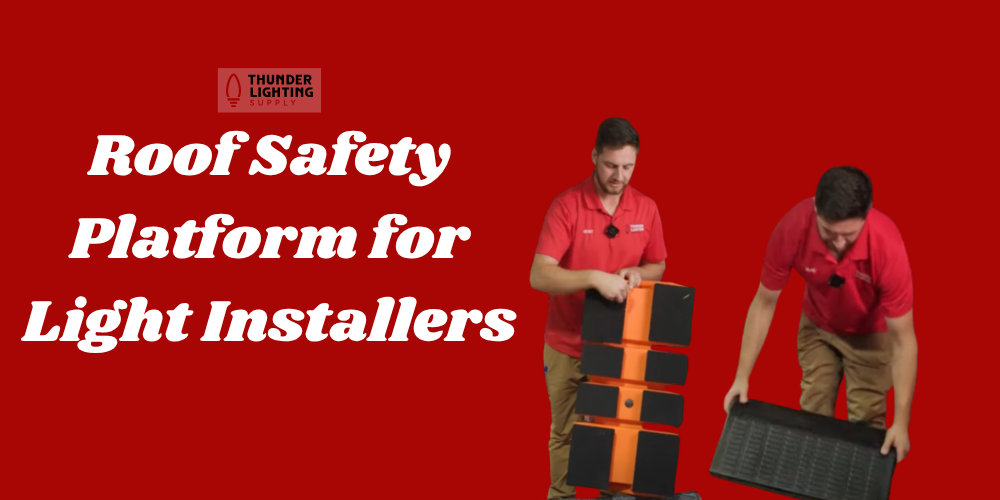
A roof safety platform gives your crew a level, planted spot to stand, kneel, or stage tools on a pitched roof. We stock two of the most requested ones — the Pitch Hopper and the STAYBULL MULTI-BASE™ — and installers ask us the same question every fall: which one should go on the truck? The short answer is that they solve different problems. The Pitch Hopper is a lightweight roof wedge that gives you a level spot to stand, kneel, or stage clips on asphalt shingles. The Staybull Multi-Base is a ladder stabilizer that doubles as a roof wedge, with ladder-foot pockets, swappable traction pads, and slots that bridge metal roof ribs.
This guide covers the roof safety platforms and roof gear light installers rely on, starting with the two we’re asked about most. If your routes are mostly shingle roofs and you need to move fast along a roofline, the Pitch Hopper earns its spot. If your crews set ladders on lower roofs, work metal roofs, or want one base for uneven ground and pitched roofs, the Staybull covers more setups. Plenty of crews run both.
Here’s how they compare, spec by spec.
Quick Pick
Choose Your Roof Work Platform
Comparing the Pitch Hopper and STAYBULL MULTI-BASE™? Here’s a quick look at which platform fits your crew and the type of roof work you handle.
Need wholesale pricing?
Create an account with Thunder Lighting Supply to access wholesale pricing on roof and ladder equipment.
What a Roof Safety Platform Does (and Doesn’t Do)
A roof platform for pitched roofs is a wedge-shaped base that cancels out the slope. Set it on the roof and the top surface sits level, so you’re standing on a flat step instead of balancing on a grade. That’s what makes a roof work platform useful on light installs: you can hold a position long enough to set clips, run socket wire, or stage bulbs without fighting the pitch.
What a roof safety platform doesn’t do is stop a fall. Both tools in this comparison are footing and stability aids, not fall-arrest devices. They work alongside a harness and anchor, not instead of them.
Types of Roof Safety Platforms and Roof Gear for Light Installers
No single tool covers every roof. Most light installation crews build their roof setup from a few categories:
- Roof wedges– Portable, level working surfaces that sit on the shingles. The Pitch Hopper is the standard here.
- Ladder bases — platforms that lock ladder feet in place on uneven ground or a lower roof and double as a roof wedge, like the STAYBULL MULTI-BASE™.
- Steep-roof assists — hook-on ladders for pitches too steep to stand on flat, like The Goat Compact Safety Ladder.
- Ladder stabilizers — top-of-ladder standoffs and gutter locks, like the Lock Jaw ladder stabilizer.
- Fall protection — harness, lifeline, and lanyard, like our roofing fall protection kit. Every other item on this list works alongside it, not instead of it.
The rest of this guide goes deep on the first two — roof wedges and ladder bases — because that’s where crews most often have to choose between two tools.
Pitch Hopper vs Staybull at a Glance
| Feature | Pitch Hopper 24″ / 32″ | STAYBULL MULTI-BASE™ |
|---|---|---|
| Primary Job | Roof wedge / working surface | Ladder stabilizer + roof wedge |
| Roof Surfaces | Asphalt shingles only | Shingles, wood shakes; standing-seam and corrugated metal with BullGrip™ Metal Pads |
| Pitch Range | Walking pitch to 12/12 (low side up to ~9/12, steep side ~9/12–12/12) | Flat to 8/12 on one side, mid-to-steep up to 12/12 on the other |
| Load Rating | 250 lb | 375 lb (user + tools) on flat, appropriate surfaces |
| Weight | ~6 lb (24″) / ~7 lb (32″) | 13 lb |
| Dimensions | 24″ or 32″ L × 8″ D × 7″ H | 33″ L × 16″ W × 7.5″ H |
| Grip Surface | Bonded friction foam | Replaceable hook-and-loop BullGrip™ micro-suction pads |
| Ladder Pockets | No | Yes — fits ladders 11.5″ min inside / 29.5″ max outside width |
| Metal Roof Rib Fit | No | Spans 12″ and 16″ O.C. ribs |
Pitch Hopper Roof Wedge: Light, Proven, Shingle-Only
The Pitch Hopper has been a go-to roofing roof platform for years, and it carries over to light installs with no learning curve. Set it on the shingles, center your weight, and you have a level surface to stand or kneel on while you clip a roofline or work a gable. Flip it over and the other face handles a different pitch range.
The wedge has two working angles. The lower-pitch side covers roofs up to about 9/12, and the steeper side covers roughly 9/12 through 12/12. The friction foam on the bottom bonds with dry asphalt shingles under weight, which is what keeps the wedge planted — and it’s also why the manufacturer limits it to asphalt shingles that are clean, dry, and free of debris, ice, or moss.
24″ or 32″ Pitch Hopper? Both sizes are dual-angle and both work to 12/12. The difference is working surface: the 24-inch Pitch Hopper gives you about 1.5 sq ft per face at roughly 6 lb, and the 32-inch Pitch Hopper gives you about 2 sq ft at roughly 7 lb. The 32″ gives a wider stance for kneeling and staging bulbs; the 24″ is easier to carry up a ladder with one hand.
Where it falls short for light crews:
- No ladder integration. It has no ladder-foot pockets, so it isn’t built to be a ladder base.
- Shingle-only. It isn’t designed for metal, tile, or slate roofs.
- The foam is part of the wedge. When the grip surface wears, you’re replacing the unit, not a pad. Some distributor spec sheets estimate 6–12 months of life under daily roofing use; seasonal light crews typically see longer life, but grip still degrades with heat, grit, and miles on the roof.
Staybull Multi-Base: A Pitch Hopper Alternative With Ladder Stabilizer Pockets
The STAYBULL MULTI-BASE™ ladder and roof stabilizer is newer to the market, and it’s the Pitch Hopper alternative we get asked about most. On a roof it works the same basic way: put it down, center your weight, stand on it. What separates it is everything built around the ladder.
The top has molded recessed pockets with backstops where your ladder feet sit, plus anti-slip tread for stepping on and off. That’s what lets one tool handle three jobs on an install:
- Ladder base on the ground — levels a ladder on sloped yards, pavers, or decking and helps stop kick-out on slick surfaces.
- Ladder base on a lower roof — gives the ladder feet a defined, locked-in spot instead of skating on shingle granules.
- Roof working platform — a level spot to stand, kneel, or stage tools on pitches up to 12/12.
It’s dual-sided like the Pitch Hopper: one side handles flat ground and slopes up to 8/12, and the other handles mid-to-steep pitches up to 12/12. The load rating is 375 lb (user plus tools) on flat, appropriate surfaces; on a pitched roof, stability depends on pitch, surface condition, pad type, and setup.
The trade-off is size. At 13 lb and 33″ × 16″, it’s roughly twice the weight of a 32″ Pitch Hopper and a lot more to carry up a ladder. It fits most extension, step, combination, and telescoping ladders as long as the ladder’s inside rail width is at least 11.5″ and the outside foot-to-foot width is no more than 29.5″ — measure your ladders before you order.
Replaceable Traction Pads vs Bonded Foam: What Wears Out First
This is the biggest long-term difference between the two, and it’s the first thing we point out when crews compare them in person.
On the Pitch Hopper, the foam is bonded to the wedge. The grip surface and the tool wear out together.
On the Staybull, the BullGrip™ traction pads attach with a heavy-duty hook-and-loop system. When the pads wear out, rip them off and press a new set on — no tools. A replacement BullGrip™ traction pad set lists at $61.73, so you’re reloading grip instead of buying a new base.
The pads also let you change surfaces. The standard pads handle shingles, wood shakes, decking, pavers, and hard floors. For metal roofs, swap to the optional BullGrip™ Metal Pads.
For a crew running several trucks, that changes the math. A pair of 32″ Pitch Hoppers costs about the same as one Staybull. The Pitch Hoppers are cheaper to put on every roof; the Staybull costs more up front but its wear part is a pad set, not the whole tool.
Metal Roof Ladder Setup: Where the Staybull Pulls Ahead
Metal roofs are where the two tools separate completely. The Pitch Hopper is an asphalt-shingle tool, full stop.
The Staybull has integrated 12″ and 16″ standing-seam slots molded into the underside. On standing-seam or corrugated panels, those grooves let the base straddle the ribs and sit flat instead of rocking on them. With the metal pads installed, you get a high-friction surface on the panel itself.
If your service area has metal-roofed homes, barns, or commercial buildings — or you’re picking up more of them as permanent lighting jobs — this alone can justify putting a Staybull on the truck.
Ladder Stabilizer for Roof Transitions: Setting a Ladder on a Lower Roof
Roof-to-roof transitions are one of the riskiest setups on a light install: the only way to reach an upper roofline is from a porch roof, garage roof, or lower story. Ladder feet on shingles can skate on loose granules or dig into soft shingles on a warm afternoon.
This is where a ladder stabilizer for roof work earns its place, and the Staybull is built for exactly this. Set the base on the lower roof, drop the ladder feet into the pockets, and the backstops keep the feet from walking under load. The wedge levels the base to the pitch, so the ladder isn’t fighting the slope.
The Pitch Hopper isn’t made for this job. Use it once you’re on the roof, not under the ladder.
For the top of the ladder, a base alone isn’t the whole setup. Pair the base with a top stabilizer like the Lock Jaw ladder stabilizer, which locks onto the ladder and the gutter, or a standoff like the Werner ladder stabilizer. The base handles the feet; the stabilizer handles the top.
Roof Platform for Christmas Lights: Which Should Your Crew Buy?
Buy the Pitch Hopper if:
- Your routes are mostly asphalt shingle residential roofs.
- Your installers spend most of their time moving along rooflines and gables, not repositioning ladders.
- Weight matters because you’re carrying it up a ladder dozens of times a day.
- You want a lower-cost option per climber. Many crews leapfrog two wedges along a roofline.
Buy the Staybull if:
- You work metal roofs, or you’re seeing more of them.
- Your jobs regularly need a ladder set on a lower roof or on uneven ground.
- You want replaceable pads instead of replacing the whole tool.
- You want one base that handles yard, deck, and roof setups.
Run both if you have multiple trucks or mixed roof types. A practical setup is Pitch Hoppers for roofline working surfaces and a Staybull on each truck for ladder setups and metal roofs.
Truck setups:
- Metal-roof truck: Staybull + spare BullGrip™ pad set
- Mixed-roof truck: 32″ Pitch Hopper + Staybull
- Two-climber crew: two 32″ Pitch Hoppers + Staybull
If you’re building out a full truck inventory, our Christmas light installation equipment checklist covers the rest of the gear. And if you’re adding safety equipment, our Christmas light installation pricing guide walks through building equipment and labor costs into your margin.
Roof Safety Equipment: What a Platform Doesn’t Replace
Both manufacturers are clear on this, and so are we: neither the Pitch Hopper nor the Staybull is a fall-arrest device. They improve footing and stability. They don’t catch you.
- Use proper fall protection — harness and anchor — and follow OSHA fall protection requirements for the work you’re doing.
- Keep your weight centered on the platform. Don’t lean uphill into the slope.
- Only use either tool on clean, dry surfaces. Frost, wet shingles, moss, leaves, and loose granules all reduce grip.
- Inspect foam or pads before every use. Worn or contaminated grip means it’s time to replace.
- Verify your ladder is set up and stable before you climb — a base doesn’t fix a bad ladder angle.
A roof safety platform is one piece of the kit. Browse the rest of our roof safety equipment for harnesses, ladder stabilizers, and related gear.
Pitch Hopper vs Staybull Side by Side
In this walkthrough, we set both tools on a pitched roof, flip the Pitch Hopper between its two angles, pull and replace the Staybull traction pads, and show the metal-roof grooves and ladder-foot pockets.
FAQs
How long does a Pitch Hopper last?
The foam pad eventually wears out. The manufacturer reports roofing crews getting over a year from the same units under daily use, so seasonal light crews typically get more. Centering your weight and avoiding the corners and edges extends its life. When the grip goes, the whole wedge is replaced.
Why not just use a couch cushion or a foam knee pad?
Because a cushion doesn’t cancel the pitch. It compresses unevenly, has no rated grip on shingles, and gives you no load rating or level top to stand on. A purpose-built roof wedge is shaped to the pitch so the top surface sits level, and it’s rated for the weight you’re putting on it.
Can you use a roof wedge on frost, dew, or wet shingles?
Don’t. Both tools rely on grip against a clean, dry surface. Roofs can hold frost or heavy dew in the morning even when the ground looks dry, and moisture, moss, and debris cut traction on foam and pads alike. Wait until the roof is dry.
