

Landscape Lighting Wire Guide for Installers

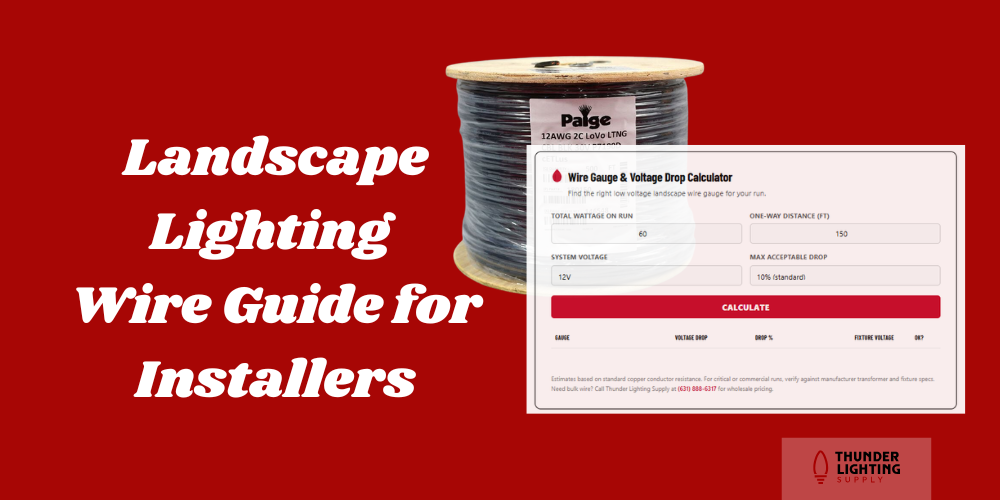
Wire is the part of a landscape lighting job nobody sees once the mulch goes back down — and it’s also the part that generates the most callbacks. Get the gauge wrong on a long run, and six months later you’re back on-site explaining why the end fixtures are dim while the ones near the transformer are blazing. This guide covers how to size low voltage landscape wire correctly, what separates one type from another, how deep and how it needs to be run, how the wire you spec interacts with the brand of fixtures on the job, and includes a free wire size calculator so you can check voltage drop before you cut a single foot.
A Guide to Landscape Lighting Wires: Types and Gauges
A guide to landscape lighting wires has to start with gauge, because gauge is the single biggest variable installers get wrong on longer runs. Landscape wire is sold in even-numbered AWG sizes, and — as with all wire — the lower the number, the thicker the conductor and the less resistance it has over distance.
| Gauge | Typical Use Case | General Run Guidance* |
|---|---|---|
| 18 AWG | Short fixture drops, branch/pigtail runs off a main line | Under 50 ft, light loads only |
| 16 AWG | Light-load runs, small residential zones | Up to ~100 ft |
| 14 AWG | Standard mid-size runs, mixed fixture counts | Up to ~150–200 ft |
| 12 AWG | Most common main-line gauge for trade installs | Up to ~200–300 ft |
| 10 AWG | Long runs or higher-wattage LED loads | 300+ ft or heavy amperage |
| 8 AWG / 6 AWG | Trunk lines from transformer on large or commercial jobs | Long-distance, high-load main feeds |
*These ranges are rules of thumb, not substitutes for calculating actual voltage drop — total wattage, run length, and target voltage at the fixture all shift the real answer. Use the calculator below for the actual number on a given run.
What we stock: Thunder Lighting Supply carries Paige low voltage landscape lighting cable in different spool options. That covers the gauge range that handles the overwhelming majority of trade runs; if the calculator below points you toward 18 AWG or 8/6 AWG for an unusual run, call for availability on those sizes.
Jacket and construction: Wire sold for this trade is generally jacketed in polyethylene (PE) or PVC rated for direct burial and continuous moisture exposure. Our Paige stock is rated for industrial-grade, all-weather UV and moisture resistance, with a flexible stranded copper design built for outdoor lighting and landscape installs. Solid-core wire is more common in fixed interior wiring and isn’t the right spec for buried runs with wire nuts, gel-filled connectors, or waterproof splice kits.
Burial Depth and Conduit: What the Code Actually Says
Landscape lighting wire doesn’t need to sit in conduit — it’s rated for direct burial — but installers still get depth and conduit questions from clients, and the answer comes from NEC 300.5 rather than a rule of thumb:
- Standard residential runs: minimum 6 inches of cover in most locations around a home.
- Under streets, driveways, alleys, and parking lots: minimum 24 inches.
- One- and two-family dwelling driveways and parking areas (residential use only): minimum 18 inches.
- Conduit is optional, not required, for direct-burial-rated low voltage wire — but running it through conduit under hardscape or high-traffic areas makes future re-pulls possible without re-trenching, which is worth the extra material cost on jobs where a re-route is likely.
These are general code minimums, not a substitute for checking local amendments — always confirm with the AHJ on a given job.
Wire Size Calculator: Voltage Drop by Gauge and Run Length
The wire size calculator below does the math that most callback-causing wiring mistakes skip. Enter the total wattage on a run, the one-way distance from the transformer to the farthest fixture, and the system voltage, and it will show voltage drop across every common gauge — plus flag the smallest gauge that keeps the run within a safe range.
Why this matters more with LED than it used to: halogen fixtures tolerated a wide voltage swing without much visible effect. LED landscape fixtures are far less forgiving — under-voltage shows up as dim or flickering output, and over-voltage shortens driver life. Most manufacturers want fixture-end voltage within roughly 10% of nominal, and tighter is better on LED-heavy runs.
This calculator gives you a solid working number for planning and bidding. For jobs with mixed loads, multiple branch runs off one trunk line, or anything close to the drop threshold, call Thunder Lighting Supply at (631) 803-9627 — we’ll help you spec the exact wire and transformer tap for the run before you order.
Wire Gauge & Voltage Drop Calculator
Find the right low voltage landscape wire gauge for your run.
| Gauge | Voltage Drop | Drop % | Fixture Voltage | OK? |
|---|
Estimates based on standard copper conductor resistance. For critical or commercial runs, verify against manufacturer transformer and fixture specs. Need bulk wire? Call Thunder Lighting Supply at (631) 803-9627 for wholesale pricing.
How to Size a Run: Worked Example
Say a run has six 6-watt LED path lights (36 total watts) at 180 feet one-way from a 12V transformer.
- Find the amperage: 36W ÷ 12V = 3 amps
- Check 12 AWG wire (1.588 ohms/1,000 ft): Voltage Drop = (2 × 180 × 1.588 × 3) ÷ 1000 = 1.71V
- Voltage drop percentage: 1.71V ÷ 12V = 14.3% — too high for an LED-heavy run
- Step up to 10 AWG (0.999 ohms/1,000 ft): Voltage Drop = (2 × 180 × 0.999 × 3) ÷ 1000 = 1.08V, or 9% — inside the safe range
That’s a real-world case where “12 AWG is standard” would have shipped a dim end-of-run fixture. The calculator above runs this same math instantly for any load and distance.
One-way distance, not round-trip: Measure from the transformer to the farthest fixture only — don’t double it yourself before entering it into the calculator. The voltage drop formula already accounts for the round-trip path the current actually travels (power out, current back), which is why the “2 ×” sits inside the calculation itself. Entering an already-doubled distance will overstate the drop and push you toward a heavier gauge than the run needs.
Brands of Landscape Lighting: Where Wire Compatibility Matters
Most brands of landscape lighting run on the same underlying electrical standard — 12V, two-conductor, low voltage — which means properly sized copper wire is compatible across systems from Dauer, Omni and Hey-O alike. Where brands actually differ is in connector style: quick-connect clips, gel-filled wire nuts, and proprietary splice systems vary by manufacturer, but the wire feeding into them doesn’t need to.
Common Wiring Mistakes That Cause Callbacks
- Undersizing the far end of a run. The last fixture on a daisy-chained run sees the cumulative voltage drop of everything before it — size for the full run length, not the average.
- Home-run vs. daisy-chain confusion. Splitting a long run into two shorter home-runs from the transformer (a “hub and spoke” layout) often solves a voltage drop problem more cheaply than jumping two wire gauges.
- Ignoring transformer tap settings. Most multi-tap transformers offer 13V, 14V, and 15V outputs specifically to compensate for planned voltage drop — pairing the right tap with the right wire size is part of the spec, not an afterthought.
- Reusing old low-voltage wire on LED retrofits. Wire sized correctly for a halogen system’s higher amperage draw may be oversized for LED loads — but wire sized too thin for the original halogen run will underperform even more on a system that’s less voltage-tolerant.
FAQs
Does landscape lighting wire need to be run in conduit?
No — it’s rated for direct burial. Conduit is optional, but it’s worth using under driveways, patios, or other hardscape where you might need to re-pull wire later without tearing anything up.
Does landscape lighting wire need to be direct burial rated?
Yes. Low voltage landscape wire should be rated for direct burial and continuous ground contact — standard interior building wire isn’t built for that exposure and will degrade faster underground.
Can I mix wire gauges on the same run?
Yes — many installers run a heavier gauge (10 or 12 AWG) as the main trunk line and step down to a lighter gauge (14 or 16 AWG) for short fixture drops off that trunk, as long as the drop stays short and low-load.
