

Leasing vs. Selling Holiday Lights: Pros, Cons, and Pricing Tips for Installers

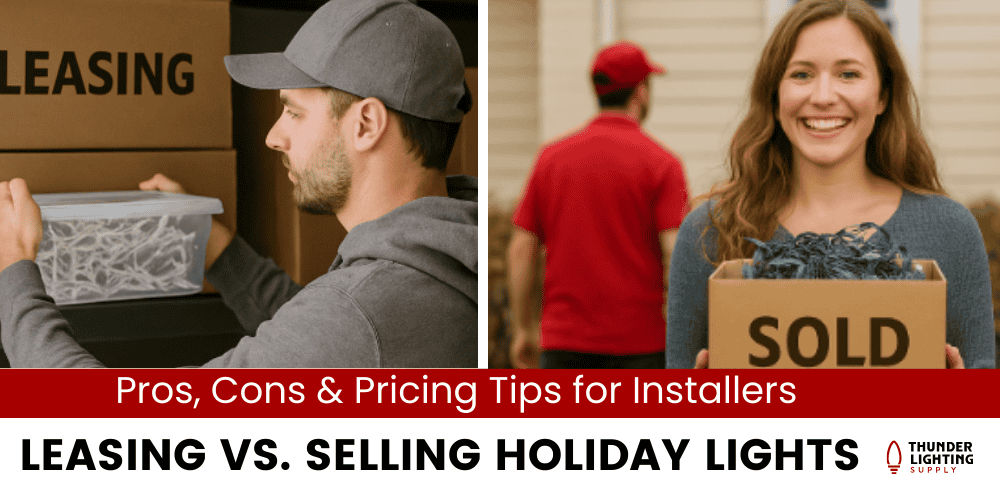
In the holiday lighting installation business, one of the most important decisions you’ll make is whether to lease your holiday lights to customers or sell them outright. Much like deciding between leasing or buying a car, this choice directly impacts your profit margins, daily responsibilities, storage requirements, and the long-term value of your business. In this guide, we’ll break down how each model works, compare the pros and cons, show you who each is best for, and share real-world pricing strategies using our Holiday Lighting Estimation Tool.
Prefer to watch instead? Here’s a quick breakdown of the difference between leasing and selling holiday lights from our expert team:
What is the Leasing Model for Holiday Lights?
In a leasing model:
- You own the lights and rent them to the customer for the season.
- You handle installation, maintenance, takedown, and storage.
- Customers have no ongoing responsibility for the lights.
If the customer leases the lights from you, you as the contractor are responsible for any maintenance and storage of the product.
Best For:
- Businesses that want predictable seasonal revenue.
- Contractors with access to storage facilities.
- Those willing to invest in inventory and maintenance.
What is the Sales Model for Holiday Lights?
In a sales model:
- The customer owns the lights from the start.
- They pay for materials, installation, and takedown in the first year.
- They handle maintenance and storage (or pay you to store them).
If you sell the customer the lights, the customer is now responsible for maintenance and any issues that happen with the lights.
Best For:
- Businesses are looking for quick cash flow.
- Contractors without storage space.
- Those who prefer one-off projects over long-term client management.
Pros & Cons: Leasing vs Selling Holiday Lights
Leasing Model
Pros of Leasing
- Recurring revenue from repeat clients year after year.
- Control over product quality (since you own the lights).
- Easier upsells (add-on services each season).
- Strong customer relationships and retention.
Cons of Leasing
- Lower profit in the first year due to material investment.
- Requires storage space for all lights off-season.
- Ongoing maintenance costs fall on you.
- Higher upfront capital investment.
Selling Model
Pros of Selling
- Higher first-year profit margins.
- No need for large storage facilities.
- Minimal long-term maintenance responsibilities.
- Faster cash flow turnaround.
Cons of Selling
- Less guaranteed repeat business.
- Lower control over product quality.
- Fewer opportunities for recurring upsells.
- Customer may source cheaper replacements in future years.
Leasing vs. Selling: Side-by-Side Comparison
| Factor | Leasing Model | Sales Model |
|---|---|---|
| Ownership | The customer owns lights | Customer owns lights |
| Maintenance | Contractor responsibility | Customer responsibility |
| Storage | Contractor stores lights | Customer stores or pays for storage |
| First-Year Profit | Lower | Higher |
| Inventory | Large inventory required | Minimal inventory needed |
| Business Resale | More assets (often used inventory) | Fewer assets |
FAQs
What should a leasing contract include?
Include lease duration, included services, maintenance responsibilities, storage terms, and liability clauses.
How should I price my installations?
Pricing should be simple, accurate, and profitable—and that’s exactly what our Holiday Lighting Estimation Tool delivers. This free, downloadable resource helps contractors calculate precise installation costs in just minutes, so you can quote with confidence every time. Whether you’re following a leasing or selling model, the tool factors in materials, labor, and takedown percentages. For leasing specifically, it ensures that you include critical expenses such as storage overhead and maintenance costs—helping you protect your margins while staying competitive.
Leasing vs. Selling: Do You Really Have to Pick Just One?
Not at all. Many successful holiday lighting businesses run a hybrid model—leasing to commercial clients who value ongoing service and maintenance, while selling to residential customers who prefer to own their lights outright. This approach lets you capture the recurring revenue benefits of leasing while still enjoying the high upfront margins of sales, giving you flexibility to adapt to each client’s needs.
Final Thoughts
Your success isn’t just about model choice—it’s about how well you service clients, manage operations, and price competitively. Stand out by combining clear contracts, smart tools, and excellent service.
Need help implementing either model? Contact Thunder Lighting Supply for premium products, training, and expert guidance.
