

Landscape Lighting Transformer Guide: Sizing, Types & Installation

To choose the right landscape lighting transformer, add the total wattage of all your fixtures and then add 20 to 25 percent extra capacity. This headroom helps prevent overheating, allows room for future expansion, and extends the transformer’s lifespan. For longer wire runs, choose a multi-tap transformer to compensate for voltage drop and maintain consistent brightness across the entire system.
Whether you’re installing a small residential pathway lighting system or a large commercial landscape, selecting the right transformer is one of the most important decisions you’ll make. The wrong transformer can lead to dim fixtures, uneven lighting, premature component failure, and costly callbacks. This guide explains how to size a transformer correctly, understand multi-tap voltage, and choose the best option for your next project.
What Does a Landscape Lighting Transformer Do?
A landscape lighting transformer converts standard 120-volt household electricity into the low voltage required by most outdoor lighting systems, typically between 12 and 15 volts. This lower voltage makes landscape lighting safer to install around gardens, walkways, patios, pools, and other outdoor spaces while supplying reliable power to every fixture.
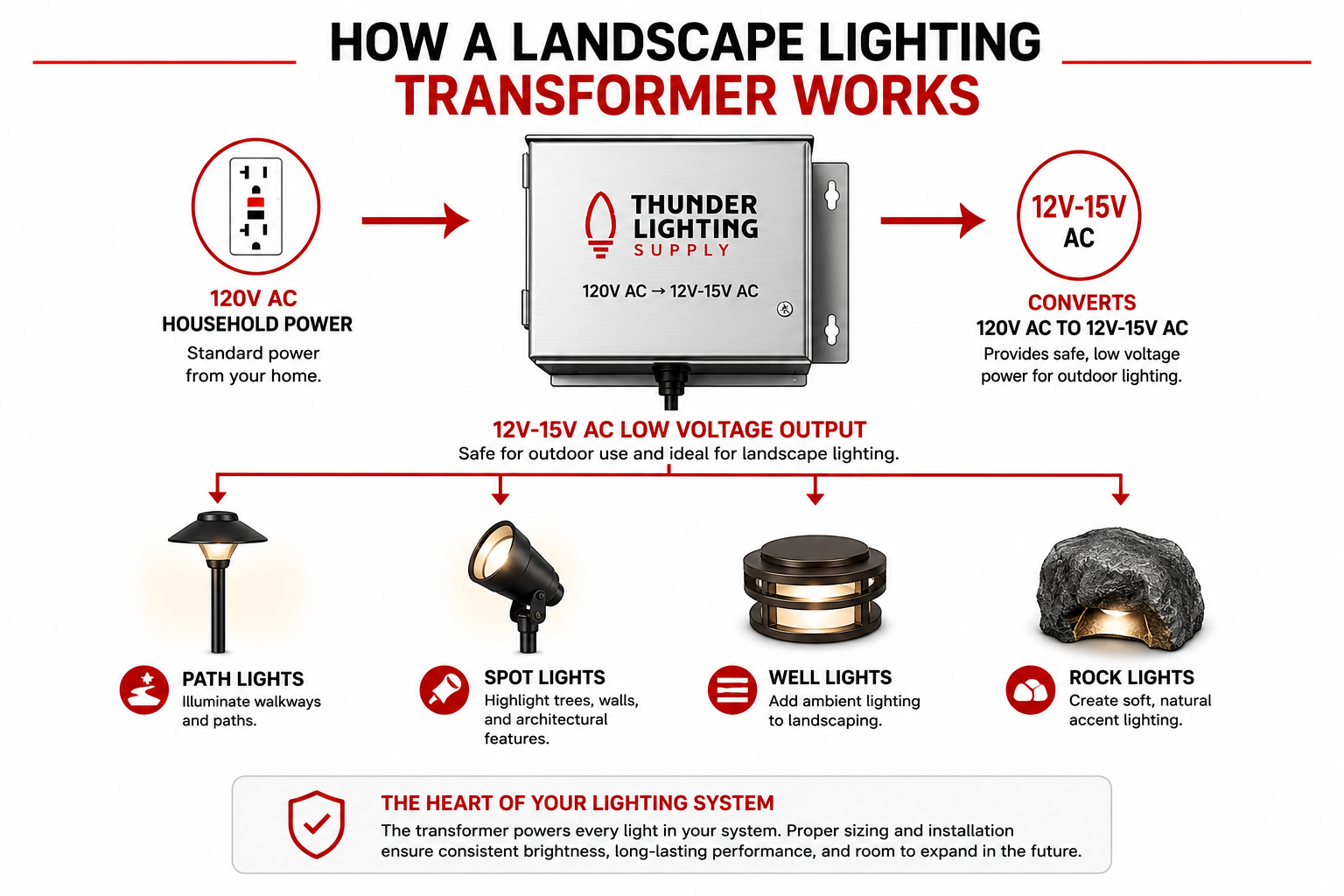
Because every light in the system depends on the transformer, its performance directly affects the entire installation. An undersized transformer may overheat or produce dim, inconsistent lighting, while an oversized unit simply adds unnecessary cost. Choosing the proper transformer ensures stable voltage, reliable operation, and room to expand the system later.
How to Size a Landscape Lighting Transformer
The goal is to power every fixture with room to spare. Running a transformer at or near max capacity shortens its life and leaves no room to add fixtures later.
- Add up total fixture wattage. Check the fixture spec sheet, not the bulb box. LED fixtures typically draw 2W-7W each; older halogen fixtures draw 20W-50W each.
- Add 20-25% headroom. A transformer should run at 75-80% of rated capacity, not 100%. A 100W load needs a transformer rated at least 125W-133W.
- Round up to the nearest stock size. Thunder Lighting Supply stocks 75W, 150W, 300W (standard and WiFi), and 600W units. For loads beyond 600W, zone multiple transformers rather than using one oversized unit.
Example: 30 path/accent fixtures averaging 3W each totals 90W. Add 25% headroom for a target of 112.5W. Spec a 150W transformer, not 300W — oversizing wastes budget on a job that doesn’t need it.
LED retrofit note: Converting an older halogen system to LED? Check the existing transformer’s minimum load rating before reusing it. Some older magnetic transformers need a minimum wattage draw to operate correctly, and a unit sized for 40 halogen fixtures may be incompatible with the same fixture count in LED. A zero-load transformer sidesteps this entirely — it runs correctly at any load, down to a single low-wattage fixture.
Multi-Tap Transformers: Matching Voltage to Wire Run Length
Most transformers offer multiple voltage taps — typically 12V, 13V, 14V, and 15V — on the same unit. These compensate for voltage drop over distance, not “strength” of output. Fixtures nearest the transformer get the lowest tap; fixtures at the end of a long run get a higher tap to make up for the voltage lost in the cable.
Copper wire has resistance, and that resistance eats voltage over distance — worse with thinner gauge wire and longer runs. A fixture 100 feet down a 12-gauge run can see several volts less than one wired directly to the transformer. Multi-tap lets you wire separate zones to separate taps so every fixture gets close to the same effective voltage, rather than the first fixture running hot and the last running dim.
For gauge selection by run length, see our landscape lighting wire guide. For diagnosing an existing dim or flickering system, see our voltage drop guide.
Choosing the Right Landscape Lighting Transformer
The best transformer depends on the size of your lighting system, the features you need, and whether you’re installing a new system or upgrading an existing one. Use the guide below to help narrow your options.
| Total Fixture Wattage | Recommended Size | Typical Use Case | In Stock |
|---|---|---|---|
| Up to 100W | 75W-150W | Small front yard, 15-25 fixtures | Multi-tap stainless (75W/150W) |
| 100W – 220W | 300W | Full front + back yard | 300W or 300W WiFi |
| 220W – 450W | 600W | Larger properties, multi-zone | 600W or 600W Lumien IQ |
| Single low-wattage LED zone | Zero-load | Small retrofits, minimum-load-sensitive jobs | 60W Zero-Load Inline |
Features to Look For
When comparing transformers, consider more than just wattage.
- Multi-tap outputs help compensate for voltage drop on longer wire runs.
- Magnetic transformers remain the preferred choice for most professional installations because of their durability and reliability.
- Smart transformers provide app control, scheduling, astronomical timers, and automation features.
- Zero-load transformers are ideal for modern LED systems with very low power consumption.
- Stainless steel housings resist corrosion and harsh weather better than plastic enclosures.
Always choose a transformer that is UL or ETL listed for wet outdoor locations and provides enough capacity for both your current lighting load and future expansion.
Adding dimming to a zone? Pair any compatible transformer with a low voltage dimmer for smooth, flicker-free control.
Transformer Maintenance
A transformer is low-maintenance, but a quick annual check — and a check after any major storm — extends its service life and prevents mid-season service calls. Inspect connections for looseness or corrosion, clean dirt and debris away from vents, confirm the timer or astronomic settings are still correct (especially after a power outage), and check for signs of moisture intrusion after heavy rain or snow.
Common Transformer Mistakes
- Sizing to 100% capacity — leaves no headroom, shortens transformer life.
- Ignoring multi-tap settings — the #1 cause of dim end-of-line fixtures.
- Mounting without weather protection — check local code for height requirements.
- Skipping the UL/ETL wet-location listing — confirm before installation, not after inspection failure.
FAQs
How many fixtures can one transformer run?
Depends on total wattage, not fixture count. A 300W transformer sized with 25% headroom can safely run about 225W of fixtures.
Can I mix voltage taps on the same transformer?
Yes. Wire shorter runs to a lower tap (12V), longer runs to a higher tap (14V-15V), on the same unit.
Is a bigger transformer always safer?
No. It won’t cause damage, but it’s a wasted materials cost. Size to the load with headroom, not to the largest unit available.
What’s the difference between a 150W and 300W transformer?
The wattage rating is the max safe load. 300W handles roughly double the fixture load and often adds zone ports for independent circuit control.
Have a spec question on a specific job? Call Thunder Lighting Supply at (631) 803-9627 or browse our full landscape lighting transformers lineup. Create a wholesale account for trade pricing and bulk order access.
